When the Grail first appears, it is not holy. In Chrétien de Troyes’s last romance, Perceval, the Story of the Grail, written in Old French verse in the 1180s or 1190s, a young knight dines in the castle of a wounded king and watches a strange procession pass through the hall. A youth carries a lance that bleeds from its tip. Then a beautiful girl carries in a graal, an ordinary word for a wide serving dish, this one golden and richly decorated. Perceval has been told it is rude to ask too many questions, so he says nothing. It is the worst mistake of his life.
That scene is the earliest surviving story of what became the quest for the Holy Grail. Everything later writers built on it, the cup of the Last Supper, Joseph of Arimathea, Galahad, Monty Python, began with a dish whose purpose Chrétien never had time to explain.
What was the Grail in Chrétien’s poem?
Chrétien gives only hints. Perceval is later told that if he had asked about the grail, and whom it served, the wounded king would have been healed. A hermit then explains that the grail held a single Mass wafer, which miraculously sustained the king’s father. The lance and the grail are treated as equally mysterious, and neither is called holy. Chrétien said he was working from a book given to him by his patron, Philip, Count of Flanders, which may or may not be true.
The poem is unfinished. After about nine thousand lines it turns to the adventures of Gawain, then simply stops, perhaps because Philip died on crusade at Acre in 1191, perhaps because Chrétien himself died. Over the next half century other poets added some fifty-four thousand lines of continuations, trying to finish the story he had started.
- c. 1170
Chrétien writes Erec and Enide, his first Arthurian romance
- c. 1177–81
Yvain and Lancelot are written, more or less side by side
- 1180s–90s
Perceval, the Story of the Grail introduces the grail, and is left unfinished
- 1191–1202
Robert de Boron makes the grail the cup of the Last Supper
- c. 1200 on
Continuations of Perceval add tens of thousands of lines
- 13th century
French prose romances make Galahad the Grail knight
- c. 1470
Malory retells the quest in English in Le Morte d’Arthur

When did the Grail become holy?
Within a few years of Chrétien. The poet Robert de Boron, writing between about 1191 and 1202, made the grail the vessel Christ used at the Last Supper, in which Joseph of Arimathea caught his blood at the crucifixion. From there the great French prose romances of the thirteenth century made it the Saint Graal, gave the quest to Lancelot’s son Galahad, and passed the story on to Thomas Malory. Our post on Le Morte d’Arthur, written in prison picks up the thread in fifteenth-century England.
Chrétien de Troyes and the first Lancelot story
The Grail is not his only gift to the legend. Chrétien worked at the court of Marie, Countess of Champagne, daughter of Eleanor of Aquitaine, and it was she, he says, who gave him both the subject and the treatment of Lancelot, the Knight of the Cart. It is the earliest known story in which Lancelot is a leading character and the first to tell of his love for Queen Guinevere. No Lancelot is known in Arthurian stories before Chrétien, and the affair became the fault line along which the Round Table would eventually break.
The poem opens with Guinevere abducted and Lancelot riding to rescue her. Left on foot, he meets a dwarf driving a cart of the kind used to parade criminals through the streets, and is offered news of the queen if he will climb in. Chrétien makes the moment a contest between reason and love, and lets reason win for exactly two steps.
The knight hesitated only for a couple of steps before getting in. Yet, it was unlucky for him that he shrank from the disgrace, and did not jump in at once; for he will later rue his delay.
Chrétien de Troyes, Lancelot, the Knight of the Cart, translated by W. W. Comfort
That pause comes back to haunt him when he finally reaches Guinevere, and it shows what makes Chrétien so readable: he cares less about the fighting than about what his knights feel, fail to say and get wrong. He did not finish this poem either. A clerk named Godefroi de Leigni wrote its ending, with Chrétien’s consent.
Where to start with Chrétien de Troyes
Perceval is not included in Four Arthurian Romances, which gathers Chrétien’s four complete Arthurian poems: Erec and Enide, Cligès, Yvain and Lancelot. They are the best way into his world, and they explain the Grail story in a way no summary can, because they show the court, the codes and the kind of knight that Perceval so spectacularly is not.
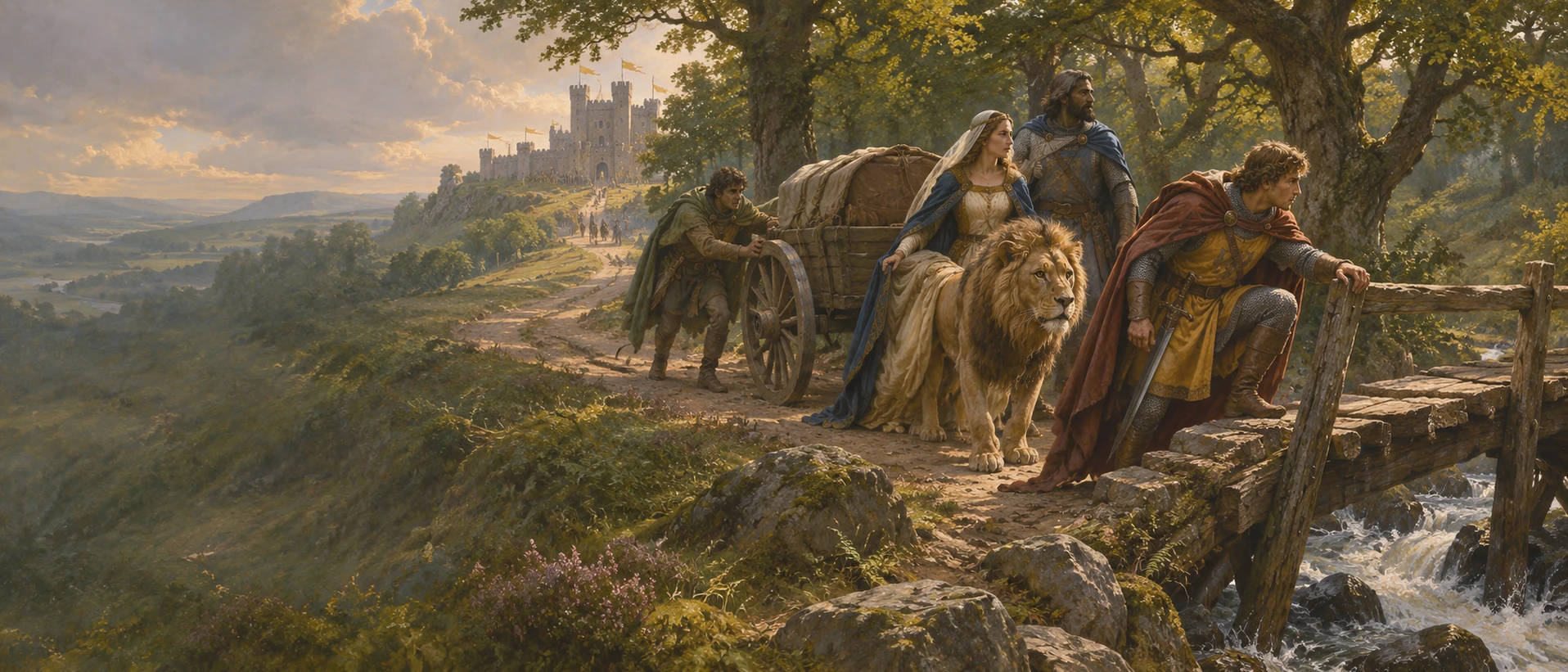
Begin with Yvain, often called his masterpiece: a knight who wins a wife, forgets his promise to her, goes mad with grief, and wins his way back with a lion at his side. Then read Lancelot for the birth of the great love affair, and Erec and Enide for a marriage tested on the road.
Four Arthurian Romances
Erec, Cligès, Yvain and Lancelot: Chrétien’s four complete romances, the source of Lancelot and Guinevere, and of knights who ride out from Arthur’s court and find out who they are.
Le Morte d’Arthur, Volume I
c. 1470. Malory’s great English retelling, where the Grail quest Chrétien began reaches its most famous form, with Galahad, Percival and Bors.


For a wider reading list, see the best King Arthur books, and for other medieval poems that still repay a modern reader, the great epic poems. If you want more French writing in English, try French classics in translation.
Chrétien did not live to explain his grail, and perhaps that is why it has lasted. Start with the knights he did finish with: open Four Arthurian Romances and ride out with Yvain.
Questions readers ask
Who first wrote about the Holy Grail?
The earliest surviving Grail story is Chrétien de Troyes’s unfinished Perceval, the Story of the Grail, written in the 1180s or 1190s. He does not call the grail holy; that idea came soon afterwards with Robert de Boron.
What is the grail in Chrétien de Troyes’s Perceval?
A richly decorated golden serving dish carried in procession at the Fisher King’s castle. A hermit later reveals that it held a single Mass wafer that sustained the wounded king’s father.
Did Chrétien de Troyes invent Lancelot?
His Lancelot, the Knight of the Cart is the earliest known story with Lancelot as its hero and the first to describe his love for Guinevere. He had named Lancelot briefly in his earlier Erec and Enide.
What are Chrétien de Troyes’s Arthurian romances?
Erec and Enide, Cligès, Yvain, Lancelot and the unfinished Perceval. The first four are complete and are often published together as Four Arthurian Romances.