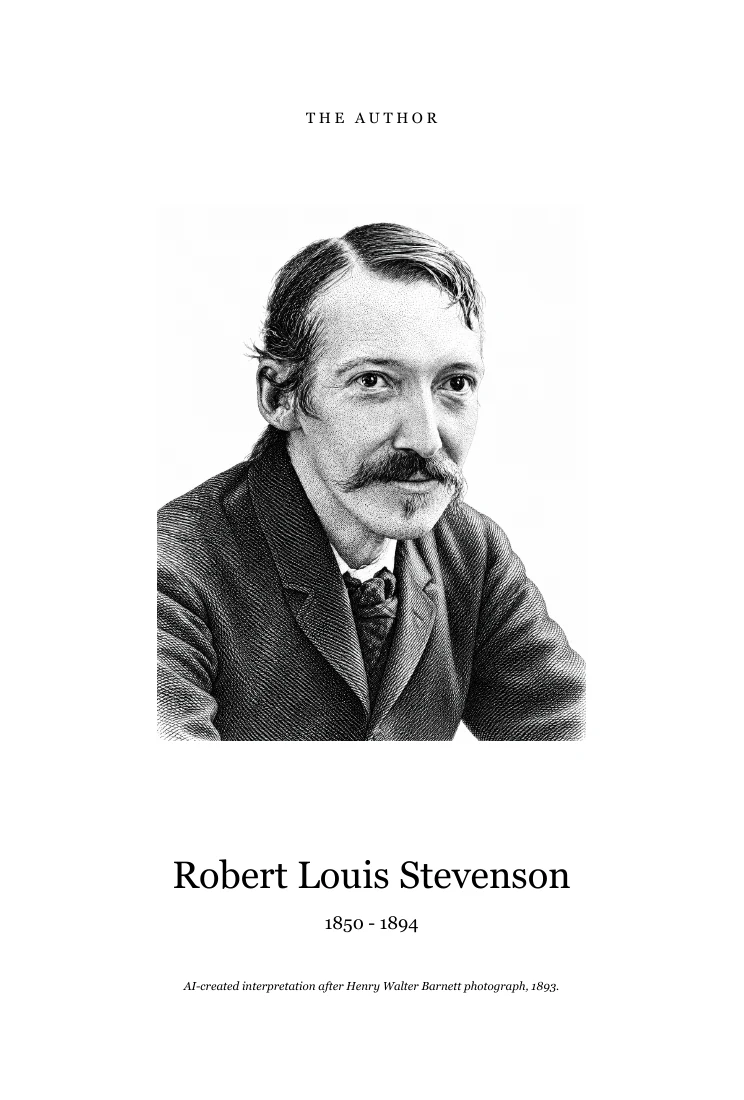
Most authors dedicate a book to someone who loved it. Robert Louis Stevenson dedicated The Black Arrow to his wife Fanny, his sharpest critic, precisely because she had never managed to finish it. He had watched, he wrote, “with interest, with pain, and at length with amusement” her attempts to read it, and he put her name in “the only book of mine that you have never read—and never will read.”
The book’s first critic was Stevenson himself. In May 1883, while he was writing it, he told his friend W. E. Henley that it was “a whole tale of tushery”, and tushery is the key to the joke. It was his word for a particular kind of costume romance, full of knights and outlaws saying “tush” and swearing “by the mass” in a borrowed medieval English. Robert Louis Stevenson knew exactly what he was writing, and he enjoyed teasing himself about it.
What did Stevenson say about The Black Arrow?
He was ill with influenza at Hyères, in the south of France, and short of money, when, it seems, the boys’ paper Young Folks, which had run Treasure Island, asked him for another serial. The letter to Henley tells the story in mock-archaic style.
Ay, friend, a whole tale of tushery. And every tusher tushes me so free, that may I be tushed if the whole thing is worth a tush.
Robert Louis Stevenson, letter to W. E. Henley, May 1883
He called it “a poor thing”, and in a second letter that month he grumbled at having to drop an essay he had nearly finished to “go full-tilt at tushery for a while”. The first of those letters goes straight on to a far more famous confession: that it was the sight of Henley’s “maimed strength and masterfulness” that had given him Long John Silver.
By October, though, his tone had changed. When his friend Sidney Colvin wrote with comments on the serial, Stevenson was pleased to hear he liked the book’s Richard of Gloucester, and admitted the truth.
Some day, I will re-tickle the Sable Missile, and shoot it, moyennant finances, once more into the air; I can lighten it of much, and devote some more attention to Dick o’ Gloucester. It’s great sport to write tushery.
Robert Louis Stevenson, letter to Sidney Colvin, October 1883
- May 1883
Stevenson calls it “a whole tale of tushery” in a letter to Henley from Hyères.
- 30 June 1883
The Black Arrow: A Tale of Tunstall Forest begins in Young Folks under the pen name Captain George North.
- 20 October 1883
The last instalment appears in Young Folks.
- 1883
Treasure Island, serialised in the same paper, comes out as a book under his own name.
- April 1888
Stevenson signs the dedication to Fanny at Saranac Lake, New York.
- 1888
The book appears as The Black Arrow: A Tale of the Two Roses, in America a few weeks before Britain.
What is The Black Arrow about?
It is set in 1460 and 1461, in the reign of “old King Henry VI” and the early Wars of the Roses. Dick Shelton, not yet eighteen, is the ward of Sir Daniel Brackley, a knight who changes sides between Lancaster and York whenever it pays. When a band of outlaws in Tunstall Forest, the Fellowship of the Black Arrow, starts shooting Sir Daniel’s men and pinning up rhymes about their crimes, Dick begins to wonder what happened to his own father.
I had four blak arrows under my belt, / Four for the greefs that I have felt, / Four for the nomber of ill menne / That have opressid me now and then.
Robert Louis Stevenson, The Black Arrow (1883)
Along the way he befriends a slight, nervous boy called John Matcham, who is not what he seems, and the second half of the book becomes a rescue, carried out in disguise and in battle, with the young Richard Crookback, Duke of Gloucester and future Richard III, as a frightening ally. Stevenson’s main source for the period was the Paston Letters, the papers of a fifteenth-century Norfolk family.
Is The Black Arrow worth reading?
Yes, if you take it for what it is: a fast, violent, often funny adventure with a strong sense of place and a hero who has to learn that neither side in a civil war is clean. Its reputation has suffered from Stevenson’s own jokes, but not everyone agreed with him. John Galsworthy called it “a livelier picture of medieval times than I remember elsewhere in fiction”, and some modern critics argue that its divided loyalties and double-dealing make it a darker and more interesting book than its label suggests.
It has been filmed several times, in 1948 with Louis Hayward, in 1985 with Oliver Reed and, the same year, in the Soviet Union. For the rest of Stevenson’s shelf, start with Where to start with Robert Louis Stevenson; for the serial that came first, see Did you know Treasure Island began with a map?. Readers who like their medieval intrigue bloody should also try books like Game of Thrones, and the historical-novel tradition Stevenson was playing with is in Walter Scott and the historical novel.
Then ignore the author’s modesty. Open The Black Arrow, listen for the Tunstall Moat House bell ringing at an unaccustomed hour, and count the pages until the first black arrow flies.
Questions readers ask
What does tushery mean?
Tushery is Stevenson’s mocking word for romantic historical fiction written in a fake old-fashioned English, full of characters saying “tush” and swearing “by the mass”. He used it about The Black Arrow in letters of 1883.
When was The Black Arrow written?
Stevenson wrote it in 1883 at Hyères, in the south of France. It was serialised in Young Folks from 30 June to 20 October 1883 under the name Captain George North, and published as a book in 1888.
What is The Black Arrow about?
It follows young Dick Shelton during the Wars of the Roses in 1460–61, as he joins forces with the outlaws of the Black Arrow against his scheming guardian, Sir Daniel Brackley, and rescues the girl he loves.
Did Stevenson like The Black Arrow?
He mocked it as “tushery” and “a poor thing” in a letter of May 1883, but by October he admitted that “It’s great sport to write tushery,” and said he was pleased that Sidney Colvin liked his Richard of Gloucester.
 Treasure Island218 pages · $14.99
 Strange Case of Dr Jekyll and Mr Hyde108 pages · $11.99
 Kidnapped276 pages · $16.99
 Catriona258 pages · $15.99