
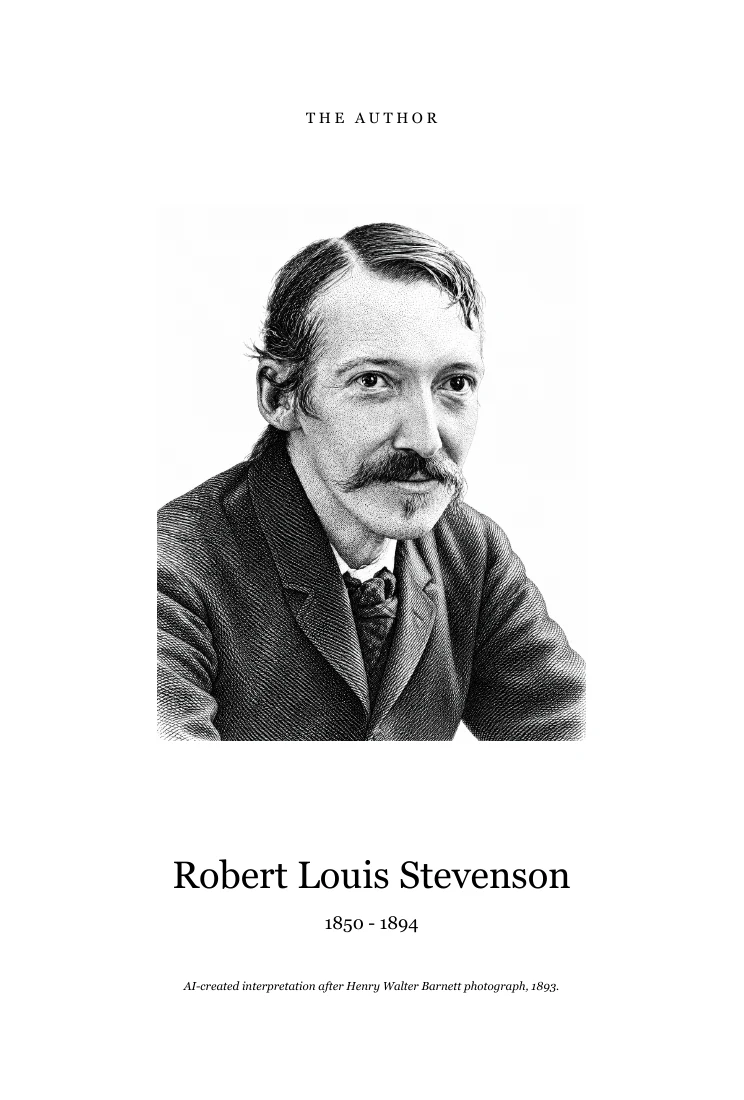
In the late summer of 1881, Robert Louis Stevenson was staying in a rented cottage in Braemar, in the Scottish Highlands, with his wife Fanny, his parents and his thirteen-year-old stepson, Lloyd Osbourne. The weather was miserable, and Lloyd was passing the time with a box of paints. Stevenson joined in, and drew the map of an imaginary island.
He gave it hills, inlets and a name: Treasure Island. Looking at it, he began to imagine the people who might have buried something there, and within days he had started writing a story to go with it. Stevenson told the whole tale years later in an essay, “My First Book”, and it is one of the best-documented origin stories in literature.
How Treasure Island was written
Stevenson wrote a chapter a day at first and read each one aloud to the household. His working title was The Sea Cook. Lloyd was the audience he had in mind, but the most enthusiastic listener turned out to be Stevenson’s father, Thomas, a lighthouse engineer with a boyish love of adventure stories. Stevenson said his father helped with details, including the inventory of Billy Bones’s sea chest.
The early burst did not last. After about fifteen chapters the story stalled, and Stevenson, whose lungs were always fragile, left Scotland for the winter in Davos, in the Swiss Alps. There, to his own surprise, the rest of the book came easily, and he finished it in a second rush of chapters.
The story was serialised in a children’s magazine, Young Folks, from October 1881, under the pen name “Captain George North”. It made little stir there. When it came out as a book in 1883, under Stevenson’s own name, it was a hit with readers of all ages and made him famous.
Where did Long John Silver come from?
Stevenson’s greatest creation was partly inspired by a friend. The poet and editor W. E. Henley had lost a leg to tuberculosis and was, by all accounts, a big, booming, charismatic presence. Stevenson later told Henley in a letter that the sight of his strength and mastery had given him the idea for Silver.
It is a compliment with an edge, because Silver is a thrilling creation: charming, fatherly, funny, utterly untrustworthy. Much of the novel’s tension comes from young Jim Hawkins, and the reader, never being quite sure which side Silver is on.
What is Treasure Island like to read today?
Fast. Stevenson cut every scene down to its essentials, and the story moves from a lonely inn on the English coast to a mutiny at sea and a desperate siege on the island in a little over two hundred pages. Jim tells most of it himself, looking back on a boyhood adventure that clearly still frightens him.
So much of our pirate lore runs through this book, from treasure maps and one-legged sea cooks to parrots on shoulders and black spots, that it can feel familiar before you start. Read it anyway. The real thing is sharper, darker and better written than any of its imitators, and the old sea song still sends a shiver:
Fifteen men on the dead man’s chest— / Yo-ho-ho, and a bottle of rum!
Robert Louis Stevenson, Treasure Island (1883)
It suits confident readers of about ten and up, and it makes a superb family read-aloud. Adults returning to it are often surprised by how morally murky it is.
Treasure Island
1883. Jim Hawkins finds a treasure map in a dead pirate’s sea chest and sails for an island with a crew he cannot trust. The book that began with a map.
Kidnapped
1886. Stevenson’s other great adventure, a chase across the Highlands with the dashing Alan Breck. A natural next book.



Where to go next
If you love the book, Stevenson’s range will surprise you; start with Where to start with Robert Louis Stevenson. For more pirates, try the best classic pirate novels, or meet Captain Hook in Barrie’s Peter and Wendy, where he is described as the only man Long John Silver ever feared. And for families, see family read-aloud adventures.
Or do what Stevenson did on that rainy afternoon: start with the map. Open Treasure Island and follow Jim from the Admiral Benbow inn to the island.
Questions readers ask
How did Robert Louis Stevenson come up with Treasure Island?
In 1881, on a rainy holiday in Braemar, Scotland, he drew and coloured a map of an imaginary island with his stepson Lloyd Osbourne. He then began writing a story to fit the map.
When was Treasure Island published?
It was serialised in the children’s magazine Young Folks in 1881–82 under the pen name Captain George North, and published as a book under Stevenson’s name in 1883.
Was Long John Silver based on a real person?
Partly. Stevenson told his friend W. E. Henley, a poet who had lost a leg, that Henley had inspired the character.
 Strange Case of Dr Jekyll and Mr Hyde108 pages · $11.99
 The Black Arrow214 pages · $14.99
 Catriona258 pages · $15.99
 The Master of Ballantrae218 pages · $14.99