THE STORY
Where does everyday happiness begin?
Bertrand Russell considers the familiar habits that feed dissatisfaction, from envy and boredom to anxiety over other people’s opinions. He then turns outward, toward work, affection, curiosity and the pleasures of attention.
ABOUT THE AUTHOR
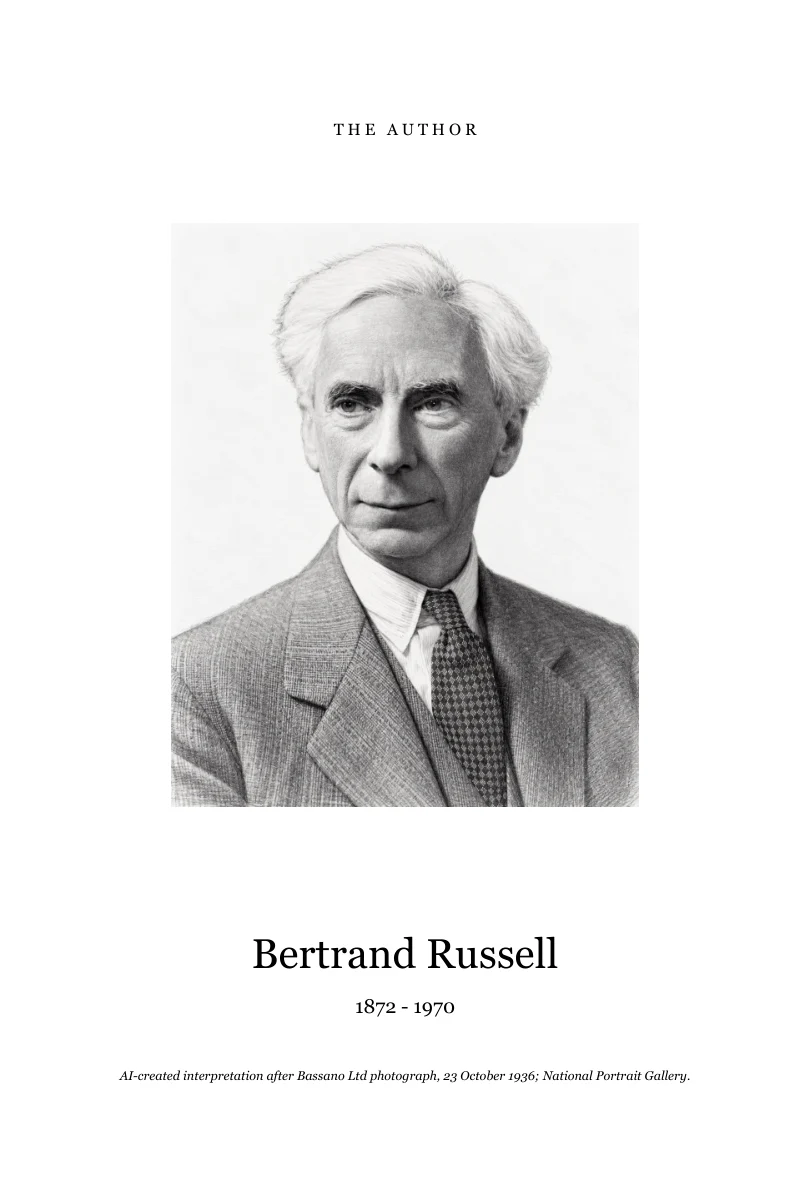
Bertrand Russell
Bertrand Russell was a British philosopher, mathematician and public writer, born in 1872. His work in logic helped shape modern analytic philosophy. Alongside technical investigations, he wrote for general readers about knowledge, education, society and the responsibilities of human beings toward one another. Russell sought precision in argument and questioned claims that rested on habit or authority. His philosophical writing asks how beliefs can be justified and what follows from the concepts used to express them. These concerns also informed his efforts to make difficult subjects accessible beyond a specialist audience. His public life included campaigning against war and nuclear weapons. He received the Nobel Prize in Literature in 1950. His opinions changed over a long career, and his influence came partly from a willingness to enter public controversy rather than confining his work to academic discussion. He died in 1970. Readers can engage with his prose by identifying the question at issue, the assumptions introduced and the steps connecting a conclusion to its evidence. Clarity does not remove the need for disagreement: an argument can be lucid and still invite challenge. Russell's work offers an opportunity to practise that distinction, treating intellectual independence as an activity rather than simply accepting the authority of a famous thinker. Biographical references: McMaster University Bertrand Russell Research Centre; Nobel Foundation. Portrait source: Bassano Ltd photograph, 23 October 1936; National Portrait Gallery. Full source records retained in the edition archive.
More about the author ↗Portrait page from this Pipcub edition