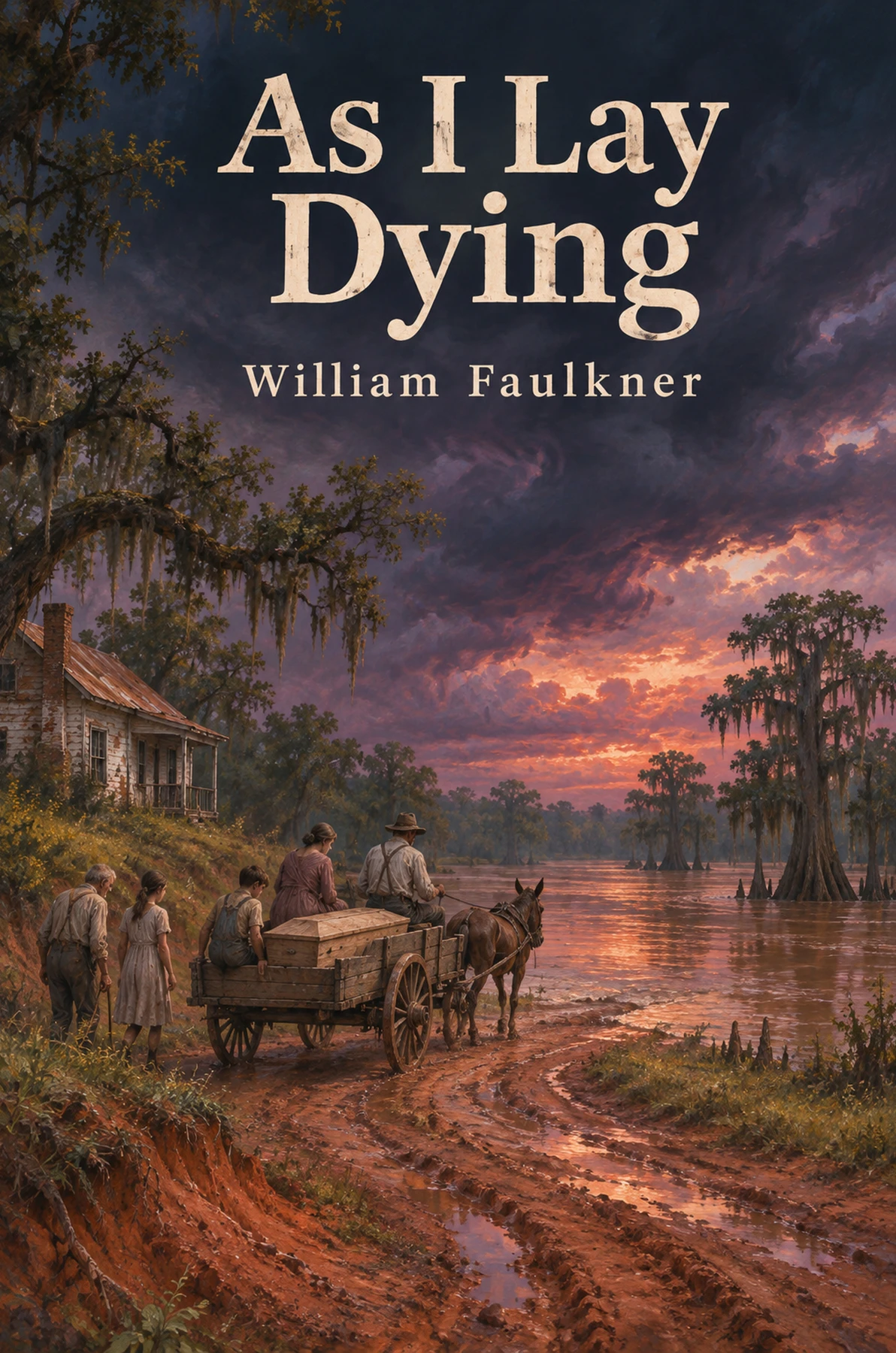
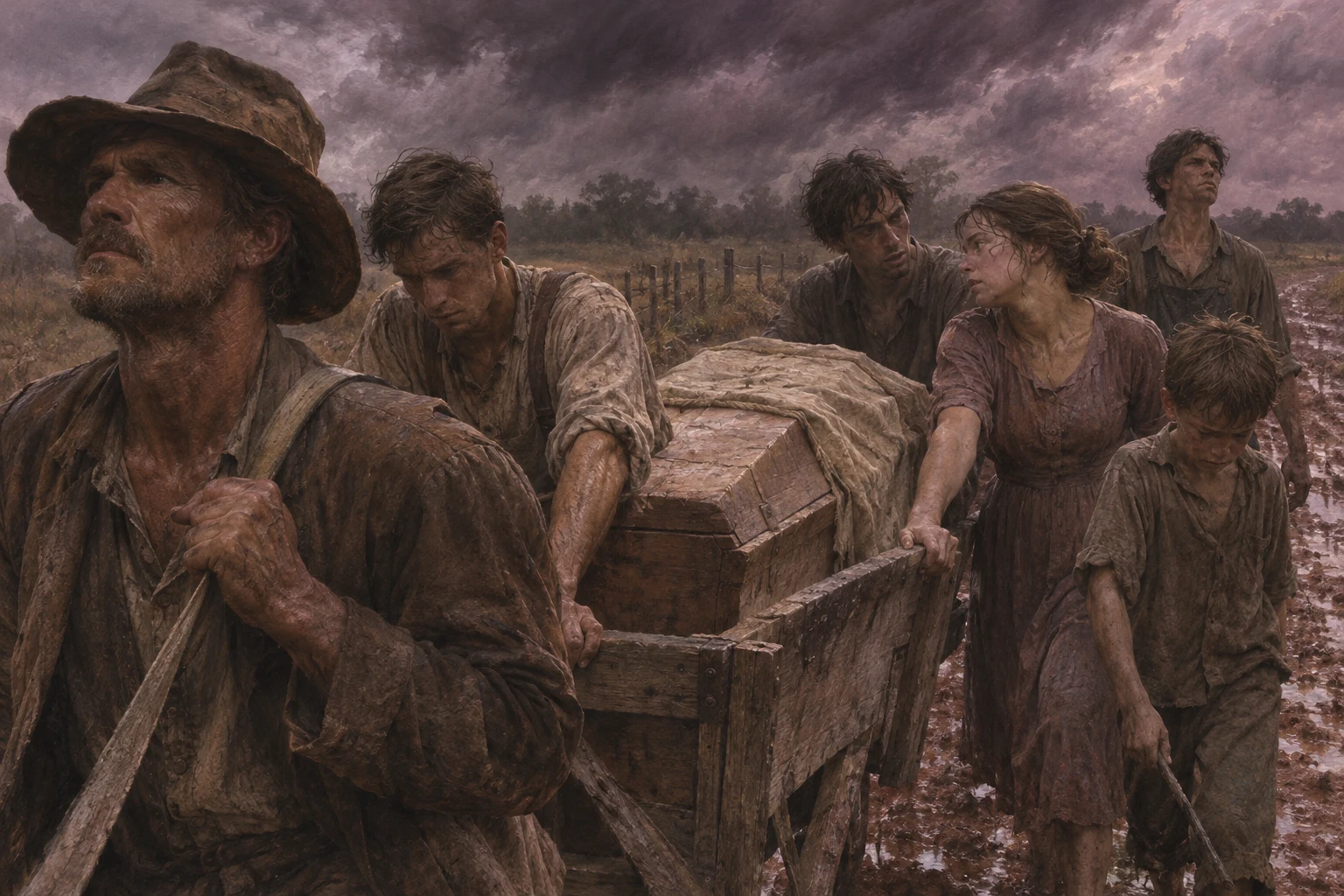
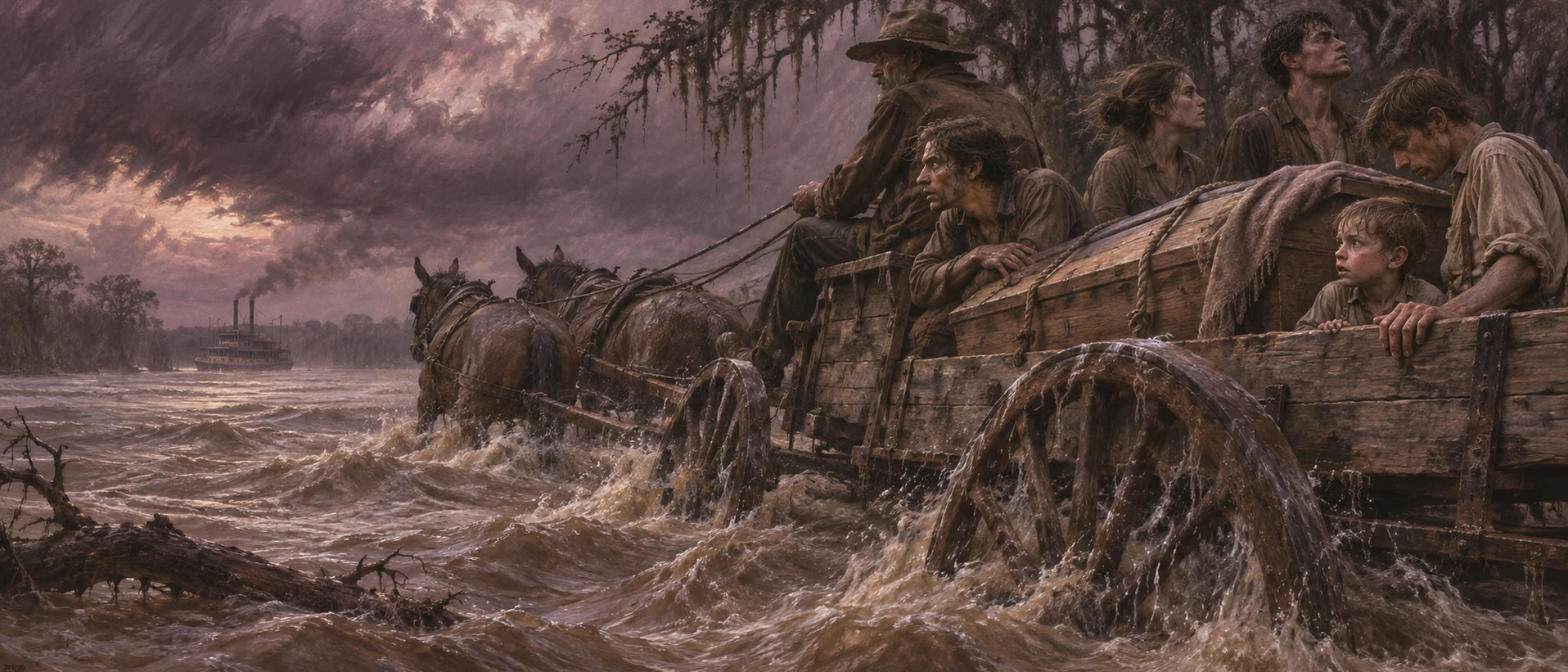
The Bundrens struggle to get their coffin wagon across the flooded river.
PIPCUB CINEMATIC EDITIONS / PAPERBACK BOOKS

As I Lay Dying

William Faulkner

Addie Bundren asked to be buried with her people. As her family hauls her coffin across Mississippi, each traveler tells a different story about the woman in the wagon and the promise that keeps them moving.
$13.99

Printed for you. Shipping calculated at checkout.

Shipping & delivery Returns

As I Lay Dying — actual Pipcub paperback cover
SCROLL INTO THE STORYAN IMAGINED WORLD · ORIGINAL AI ART
The family shoulders Addie’s coffin beneath a storm-dark sky.

THE STORY

One river stands between them and Jefferson.

Addie Bundren asked to be buried with her people. As her family hauls her coffin across Mississippi, each traveler tells a different story about the woman in the wagon and the promise that keeps them moving.

Rain streaks the coffin beside Cash’s carpenter’s square.

THE WORLD OF THE BOOK

As I Lay Dying

Rain streaks the coffin beside Cash’s carpenter’s square.

As I Lay Dying front cover
Read the interior preview

LOOK INSIDE

Open a book.
Enter a world.

Preview six pages from this edition. Select a page to enlarge it, or use the arrows to keep reading.

Spread 1 of 3

As I Lay Dying · PDF page 5
Actual interior PDF page 5 of As I Lay Dying
Read accessible text

Darl Jewel and I come up from the field, following the path in single file. Although I am fifteen feet ahead of him, anyone watching us from the cotton-house can see Jewel’s frayed and broken straw hat a full head above my own. The path runs straight as a plumb-line, worn smooth by feet and baked brick-hard by July, between the green rows of laid-by cotton, to the cotton-house in the centre of the field, where it turns and circles the cotton-house at four soft right angles and goes on across the field again, worn so by feet in fading precision. The cotton-house is of rough logs, from between which the chinking has long fallen. Square, with a broken roof set at a single pitch, it leans in empty and shimmering dilapidation in the sunlight, a single broad window in two opposite walls giving on to the approaches of the path. When we reach it I turn and follow the path which circles the house. Jewel, fifteen feet behind me, looking straight ahead, steps in a single stride through the window. Still staring straight ahead, his pale eyes like wood set into his wooden face, he crosses the floor in four strides with the rigid gravity of a cigar-store Indian dressed in patched overalls and endued with life from the hips down, and steps in a single stride through the opposite window and into the path again just as I come around the corner. In single file and five feet apart and Jewel now in front, we go on up the path toward the foot of the bluff. Tull’s wagon stands beside the spring, hitched to the rail, the reins wrapped about the seat stanchion. In the wagon-bed are two chairs. Jewel stops at the spring and takes the gourd from the willow branch and drinks. I pass him and mount the path, beginning to hear Cash’s saw. When I reach the top he has quit sawing. Standing in a litter of chips, he is fitting two of the boards together. Between the shadow spaces they are yellow as gold, like soft gold, bearing on their flanks in smooth undulations the marks of the adze blade: a good carpenter, Cash is. He holds the two planks on the trestle, fitted along the edges in a quarter of the finished box. He kneels and As I Lay Dying 2

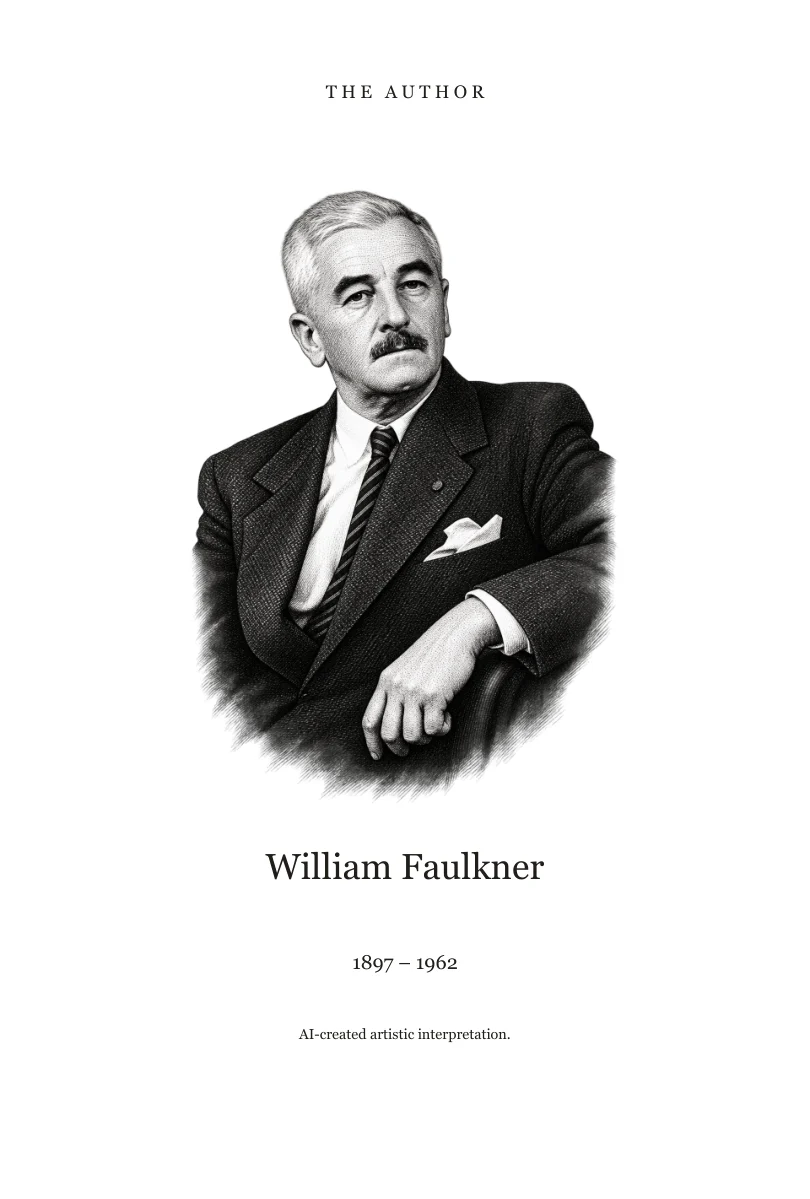
Portrait page from this Pipcub edition · William Faulkner

ABOUT THE AUTHOR

William Faulkner

William Faulkner was an American novelist and short­story writer closely associated with Mississippi. In The Sound and the Fury, he shifts between narrators whose ways of experiencing time change how readers understand the Compson family. Faulkner grew up in Oxford, Mississippi. Its surroundings helped him invent Yoknapatawpha County, a place whose households, roads and contested memories reappear across his fiction. Readers can meet a person at the edge of one narrative and find that another family remembers the same person quite differently. Faulkner also wrote short stories and worked for periods as a screenwriter. He received the Nobel Prize in Literature for 1949. The Sound and the Fury asks its reader to do some of the work that an orderly family history might otherwise supply. A voice, a remembered name or a recurring image can identify a relationship before a speaker explains it. Each return to the Compson household changes the significance of details already encountered.

More about the author ↗

Portrait page from this Pipcub edition
FREE TO READ

Take it with you.

As I Lay Dying is in the public domain, so its words belong to everyone. Download our edition free. No account needed.

Read it in your browser ↗
Add it to your reading app
iPhone & iPad
Tap download, then open the file from Safari’s downloads, tap Share and choose Books. It stays in your Apple Books library.
Android
Tap download, open the file and choose Google Play Books. Or, in Play Books, go to Library, tap ⋮ and choose Upload files.
Kindle
Send the file to your Kindle library with Amazon’s Send to Kindle.
Kobo, Moon+ Reader and other apps
Open the downloaded file with the app, or use the app’s import option.

KEEP BROWSING

More from the library.

Arsène Lupin cover

Arsène Lupin

Maurice Leblanc

Arthur Glyn : and other stories cover

Arthur Glyn : and other stories

Ruth Lamb

As a thief in the night cover

As a thief in the night

R. Austin Freeman

As You Like It cover

As You Like It

William Shakespeare

Aspects of the Novel cover

Aspects of the Novel

E. M. Forster

At Aboukir and Acre: A Story of Napoleon's Invasion of Egypt cover

At Aboukir and Acre: A Story of Napoleon's Invasion of Egypt

G. A. Henty

Browse the complete library ↗
YOUR NEXT CHAPTER

Your book bag 0

A little escape. A story to keep.

Loading your book bag…