
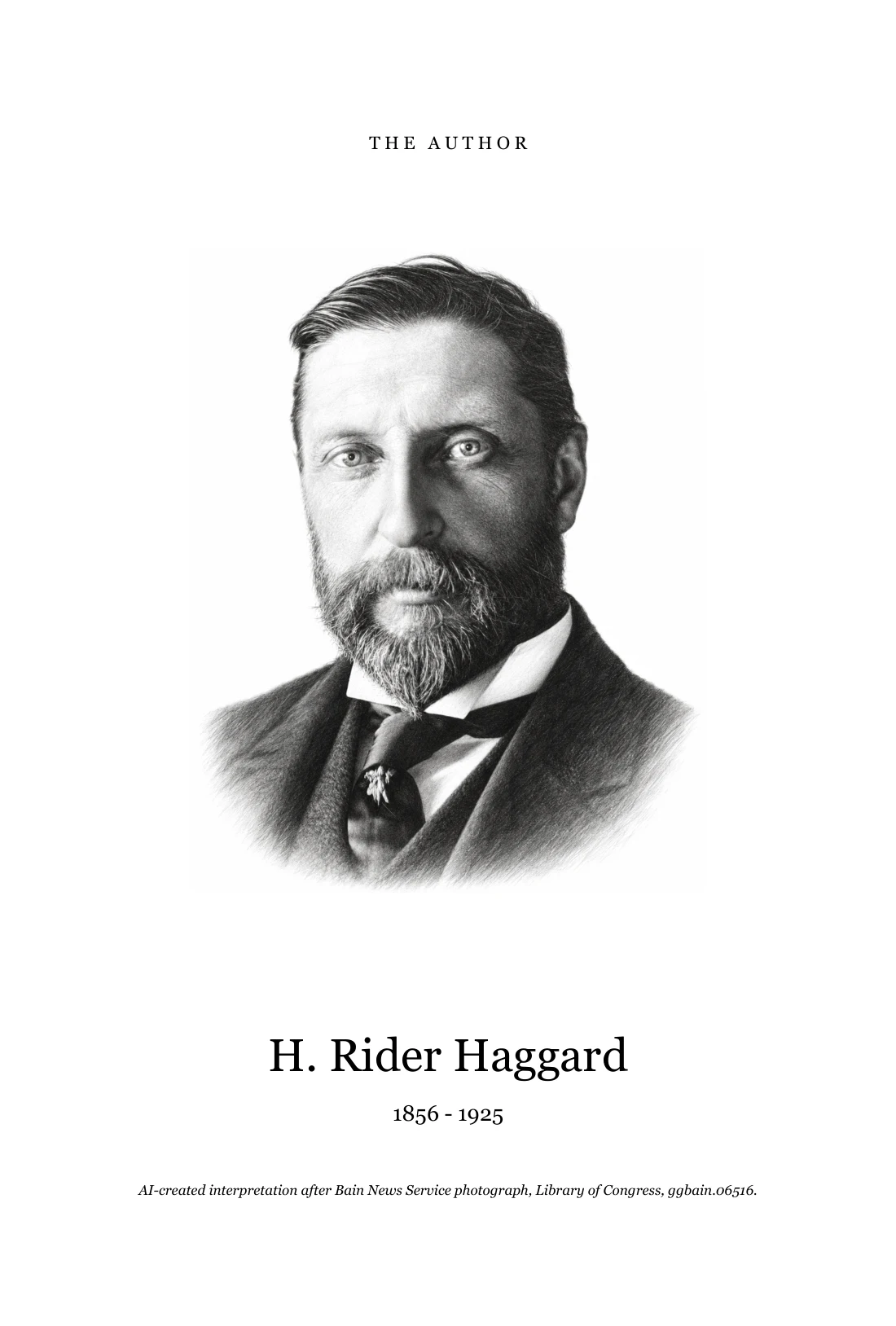
In about six weeks, in February and March 1886, H. Rider Haggard wrote one of the most influential adventure novels in English. He later described working on She almost without rest, and the speed shows in the best way: the book has the urgency of a fever dream. It ran as a serial in the illustrated weekly The Graphic from October 1886 and came out as a book in January 1887, and its title character has never quite left the culture since.
She has a direct sequel, Ayesha, the Return of She (1905), which picks up the story nearly twenty years later. Haggard then wrote two more books about her, both set before the first: She and Allan (1921), a crossover with his hunter Allan Quatermain, and Wisdom’s Daughter (1923), Ayesha’s own account of her early life. Read She first and Ayesha second; the prequels can wait until you are hooked.
Is there a sequel to She?
Yes. Haggard wrote four books about Ayesha in all, and here they are in the order they were published:
- She: A History of Adventure (1887). The original, and the one to start with.
- Ayesha, the Return of She (1905). The true sequel, set in Central Asia.
- She and Allan (1921). A prequel in which Allan Quatermain travels to Kôr.
- Wisdom’s Daughter (1923). Ayesha tells her own story, from her youth in the ancient world.
- $16.99
She
1887. Holly, a plain and bookish Cambridge man, and his golden-haired ward Leo follow an ancient inscription to Africa and the woman the locals call She-who-must-be-obeyed. Imperial romance shading into something much eerier.
- $16.99
Ayesha, the Return of She
1905. Nearly two decades on, Holly and Leo are still searching, this time across the mountains of Central Asia, from a remote lamasery to a city ruled by a jealous queen. Grander, more mystical, and the proper ending to their story.



What happens in She?
Horace Holly is a Cambridge scholar so ugly that his college nicknames him Charon, after the ferryman of the dead. When a dying friend leaves him his young son, Leo Vincey, he also leaves a locked box to be opened on the boy’s twenty-fifth birthday. Inside is a potsherd covered in ancient writing, which tells of a priestess-queen in the African interior and a flame that confers unending life.
IN EARTH AND SKIE AND SEA / STRANGE THYNGS THER BE
Doggerel couplet from the Sherd of Amenartas, the epigraph of She (1887)
Holly, Leo and their servant Job sail for Africa, survive a squall at sea and the fever-ridden swamps, and are carried to the caves of Kôr, a dead city whose present-day inhabitants are ruled by a veiled woman known only as She-who-must-be-obeyed. She is Ayesha: brilliant, imperious, terrifying and, she says, more than two thousand years old. She has been waiting all that time for a man she once loved, and she believes Leo may be him.
What follows is a philosophical romance disguised as a jungle adventure, full of debates about love, power and mortality held in rock-cut halls stacked with the embalmed dead. It is also a book of its time, steeped in imperial ideas about race and civilisation, which modern readers will notice.
Ayesha: The Return of She
The sequel ran in The Windsor Magazine from December 1904 to October 1905, illustrated by Maurice Greiffenhagen, and was published as a book in 1905. Holly narrates again, now an old man, and his first words set the tone: “Hard on twenty years have gone by since that night of Leo’s vision.”
We will say no more about how She ends, except that it leaves Holly and Leo with a reason to search. Ayesha follows them across Asia for sixteen years until they reach a lamasery among the snows, where an abbot warns them to turn back. Beyond lie a kingdom called Kaloon, its scheming ruler the Khania Atene, and a volcano where a priestess of a forgotten cult keeps her face hidden. Haggard leans hard into reincarnation and Buddhist philosophy here, and the result is one of his most atmospheric books.
Read She and Ayesha together and you have a complete love story spanning millennia, with a beginning, a long middle in the wilderness and an ending Haggard clearly meant to be final. That he came back to the character twice more says something about how much she meant to him, and to his readers.

The prequels: She and Allan and Wisdom’s Daughter
She and Allan is a gift for Haggard fans, bringing Allan Quatermain and his Zulu friend Umslopogaas to Kôr years before Holly and Leo arrive. It works best once you know both heroes; see Allan Quatermain in order. Wisdom’s Daughter goes further back still, giving Ayesha’s own account of her early life.
She on screen
She has been filmed many times. The 1935 Hollywood version, directed by Irving Pichel and Lansing C. Holden, moved the lost kingdom to the Arctic and starred Helen Gahagan in her only film role. Hammer’s 1965 version, directed by Robert Day, cast Ursula Andress as Ayesha, with Peter Cushing as Holly and Christopher Lee in support. Both take liberties; neither captures the strange, brooding voice of the books.
Haggard’s queen also left marks on later fantasy: Tolkien is said to have valued the book, and C. S. Lewis’s White Witch is often counted among her descendants. We trace that line in Fantasy before Tolkien, and Lost world novels follows the explorers who came after Holly. For how Haggard began his career, see Was King Solomon’s Mines really written on a bet?
Begin with the box, the potsherd and the night Leo turns twenty-five. She is long, but it moves, and when you close it you will want Ayesha, the Return of She within reach.
Questions readers ask
Is there a sequel to She by H. Rider Haggard?
Yes. Ayesha, the Return of She (1905) is the direct sequel, set nearly twenty years later in Central Asia. Haggard also wrote two prequels, She and Allan (1921) and Wisdom’s Daughter (1923).
What order should I read the Ayesha books in?
Read She (1887) first and Ayesha (1905) second. She and Allan and Wisdom’s Daughter are prequels and make most sense after the first two.
Where does the phrase “She who must be obeyed” come from?
It comes from Haggard’s She (1887), where it is what Ayesha’s subjects call her. The phrase has been borrowed and joked about ever since.
 King Solomon's Mines222 pages · $14.99
 Allan Quatermain268 pages · $15.99
 Eric Brighteyes292 pages · $16.99
 The People of the Mist388 pages · $19.99