
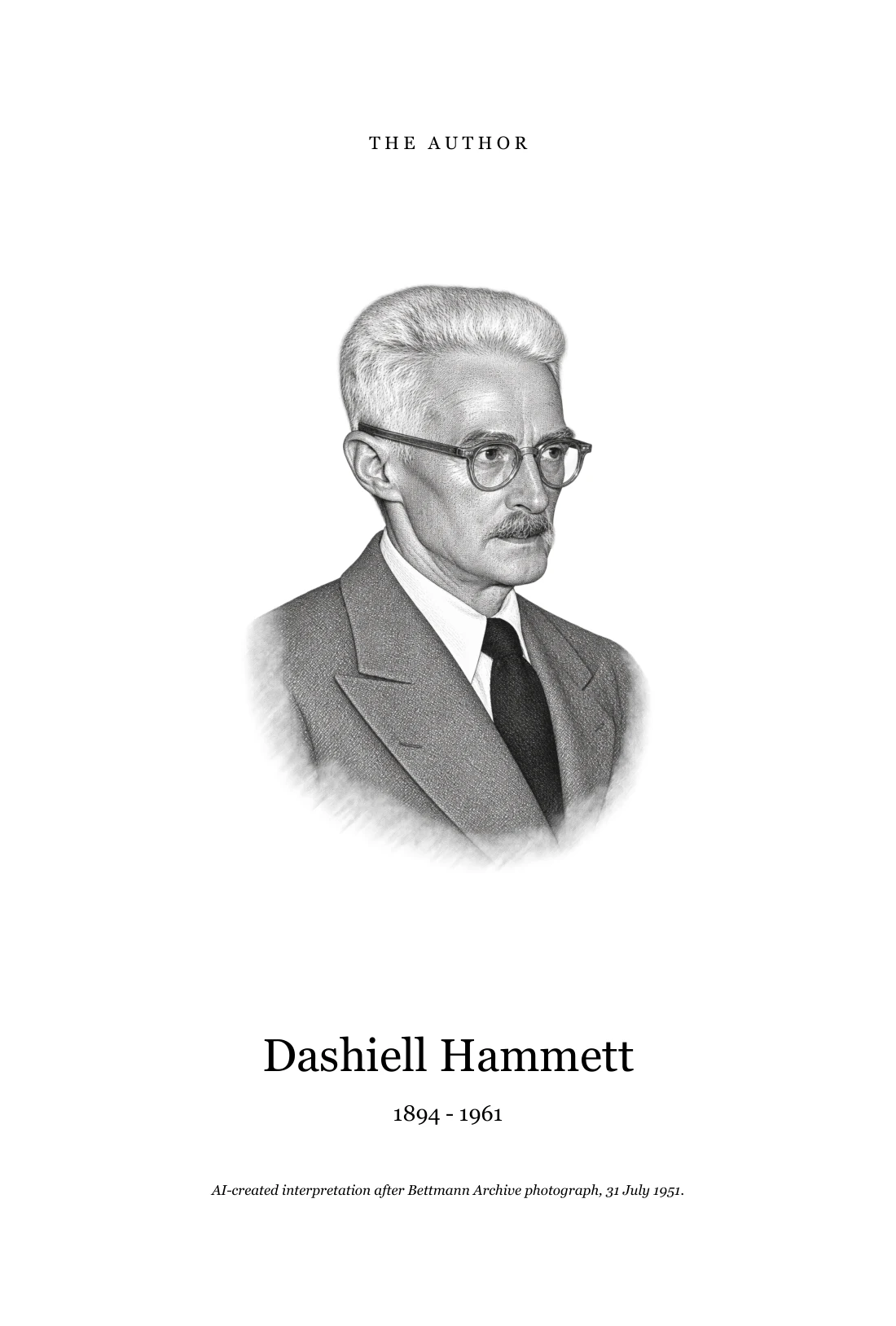
“The stuff that dreams are made of” is one of the most famous lines in American cinema. It is spoken by Humphrey Bogart at the end of the 1941 film of The Maltese Falcon, and it appears nowhere in the novel. That surprises people, partly because so much of the film is lifted straight from the book, and partly because it is easy to assume that a detective as famous as Sam Spade must have a shelf of novels behind him.
He does not. Dashiell Hammett wrote only one novel about Sam Spade, The Maltese Falcon, published in 1930, and three short stories in 1932. Every later Spade, from Bogart to the radio serials, comes from that one book.
How many Sam Spade books are there?
Just the one novel. The Maltese Falcon first ran in five parts in the pulp magazine Black Mask, from September 1929 to January 1930, and Knopf published the revised book in 1930. Two years later Hammett brought Spade back for three short stories: “A Man Called Spade” and “Too Many Have Lived” in The American Magazine, and “They Can Only Hang You Once” in Collier’s. A fourth story, “A Knife Will Cut for Anybody”, stayed unpublished until 2013.
That was the end of him, as far as Hammett was concerned. His other famous creations went elsewhere: the nameless Continental Op of Red Harvest, and Nick and Nora Charles of The Thin Man. In 2009 the novelist Joe Gores published an authorised prequel, Spade & Archer, but the original Spade remains a one-book man.
Who was Sam Spade based on?
Partly on Hammett himself. His given name was Samuel, and before he wrote fiction he spent several years as an operative for the Pinkerton detective agency, by most accounts including a spell in San Francisco, where the novel is set. But Hammett later insisted that Spade had no original. He described him instead as a dream figure: the man most of the detectives he had worked with would have liked to be.
The novel introduces him in a famous paragraph of geometry, built out of a run of v-shapes, which ends with a line nobody forgets:
His yellow-grey eyes were horizontal. The v motif was picked up again by thickish brows rising outward from twin creases above a hooked nose, and his pale brown hair grew down—from high flat temples—in a point on his forehead. He looked rather pleasantly like a blond satan.
Dashiell Hammett, The Maltese Falcon (1930)
Blond, not dark: Bogart’s Spade has rather overwritten the book’s in most readers’ minds.
The other surprise for readers who know only the film is how little Hammett lets us inside Spade’s head. The novel watches him from the outside, recording what he says and does and almost never what he thinks. His motives emerge from his behaviour, and right up to the last chapters you cannot be entirely sure which side he is on. That uncertainty is the engine of the book.
Is the Maltese Falcon real?
The jewelled bird is invented. The history behind it is not. In the novel, the fat man Gutman tells Spade how the Emperor Charles V gave Malta to the Knights Hospitaller in 1530, on condition that they paid him a yearly tribute of one falcon. That really happened: the grant required a falcon to be presented each year on the Feast of All Saints, and the payment continued until the French expelled the Knights in 1798. The real tribute was a live hunting bird, not a jewel-encrusted statuette, but Hammett’s invention has eclipsed it completely.
The Maltese Falcon on screen and radio
The novel was filmed three times in a decade. Ricardo Cortez played Spade in 1931. In 1936 it was remade as a comedy, Satan Met a Lady, with Warren William as a detective renamed Ted Shane. Then in 1941 John Huston, making his debut as a director, filmed it again with Bogart, keeping so much of Hammett’s dialogue that the book reads in places like the shooting script. It received three Academy Award nominations, including Best Picture.
Spade also had a long life on the radio. The Adventures of Sam Spade ran from 1946 to 1951, with Howard Duff in the role for most of that time. None of it added a single page to Hammett’s account.
To see how the film and novel compare in detail, read The Maltese Falcon: the novel vs. the 1941 film. If Spade has given you a taste for crime, Classic mystery novels for beginners suggests where to go next, and Golden Age detective novels to start with shows what the British were doing at the same moment, in a very different key.
Then meet the original. Open The Maltese Falcon at the v-shaped portrait of its hero, and you will find a harder, stranger and blonder Sam Spade than the one on the screen.
Questions readers ask
How many novels feature Sam Spade?
Only one, The Maltese Falcon (1930). Dashiell Hammett also wrote three Sam Spade short stories published in 1932, and a fourth that appeared only in 2013.
Is “the stuff that dreams are made of” in The Maltese Falcon novel?
No. The line is spoken by Humphrey Bogart at the end of the 1941 film and echoes Shakespeare’s The Tempest. It does not appear in Hammett’s novel.
Was the Maltese Falcon a real object?
No, the jewelled statuette is fictional. But the story behind it is based on fact: from 1530 the Knights Hospitaller owed the Emperor Charles V and his successors, as rulers of Sicily, a yearly tribute of one falcon in return for Malta.
 Red Harvest200 pages · $13.99
 The Dain Curse210 pages · $14.99