Samuel Butler, the Victorian novelist who wrote Erewhon, had a theory about the Odyssey. He was convinced that it was not the work of an old blind bard at all, but of a young woman living in Sicily, and he set out his evidence in a book called The Authoress of the Odyssey in 1897. The idea never won over scholars, though Robert Graves later built a novel, Homer’s Daughter, around it. In 1900, three years after The Authoress, Butler published a translation of the poem into plain English prose, and that translation is the one in our edition.
It matters for the question of length. The original is a poem of 12,109 lines in the standard count, divided into twenty-four books. Butler did not try to make it a poem in English; he turned it into straightforward prose, and our edition of The Odyssey runs to 288 pages. Fifty pages an hour is the speed behind our book cards’ estimates, so that is roughly six hours. Verse translations, set out line by line, usually take up more pages and a little more time, and every reader’s pace is their own.
Tell me, O Muse, of that ingenious hero who travelled far and wide after he had sacked the famous town of Troy.
Homer, The Odyssey, translated by Samuel Butler (1900)
How many books are in the Odyssey?
Twenty-four, the same as the Iliad. The division into books is very old but was probably made long after the poem was composed, and it is not quite as neat as it looks: some books are twice the length of others. In our edition they average about a dozen pages each, which is fifteen minutes or so of reading.
More useful for planning are four larger movements. Two of them had names of their own in the ancient world: the Telemachy, and the Apologoi, Odysseus’s account of his wanderings.
- Books 1–4, the Telemachy: Odysseus is missing, suitors are eating his house bare, and his son Telemachus sets out to find news of him. A little under a fifth of the poem, and Odysseus himself does not appear.
- Books 5–8: the hero at last, leaving the nymph Calypso’s island on a raft and washing up, shipwrecked, among the Phaeacians.
- Books 9–12, the tale told at the Phaeacian court: the Cyclops, the witch Circe, the visit to the dead, the Sirens, Scylla and Charybdis. Most of the adventures people remember live in these four books.
- Books 13–24: home to Ithaca in disguise, the beggar in his own hall, the bow and the reckoning. Nearly half the poem.
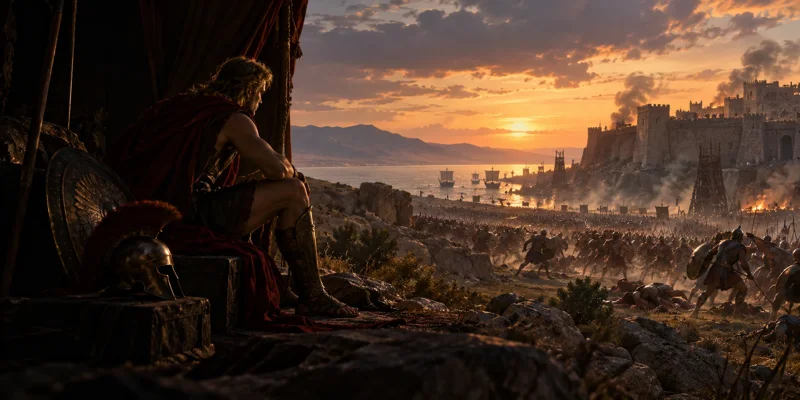
A plan for reading the Odyssey
The simplest plan is one book a day for twenty-four days, fifteen minutes or so at a time. If you prefer longer sittings, use the four movements above: the first three make an evening each, and the long homecoming takes two or three more. The Odyssey also begins in the middle of things, with Odysseus already ten years overdue; if you know that before you start, the opening books with Telemachus make far more sense. And try reading a few pages aloud: the poem grew out of a tradition of oral performance, and Butler’s prose still carries the rhythm of a story meant to be heard.
One small warning about this translation. Butler uses the Latin names that were standard in his day, so Odysseus is Ulysses, Athena is Minerva and Zeus is usually Jove. Once you know that, the prose is plain and easy to follow. For more help getting started, see how to read the Odyssey.
Is the Odyssey shorter than the Iliad?
Yes. The Iliad has 15,693 lines to the Odyssey’s 12,109, and it feels longer too, because so much of it is battle. Many readers find the Odyssey the easier of the two to begin with; we weigh up the order in which to read first, the Odyssey or the Iliad, and give the Iliad its own reading guide in how long is The Iliad.
The Odyssey
Butler’s plain prose version of 1900: a war veteran ten years late home, a son searching for him and a wife holding off a houseful of suitors.
The Iliad
The war that came first, in Pope’s couplets: a short stretch near the end of the siege of Troy, and the anger of Achilles.
Ulysses
1922. Joyce’s Dublin answer to Homer, a single day loosely mapped onto the Odyssey’s episodes. Read Homer first and the jokes land.


If you read Joyce afterwards, see how long is Ulysses before you start; it is a much longer journey. But the original is waiting, and it is shorter than you think. Begin with the council of the gods in The Odyssey, and let Homer start you in the middle of things.
Questions readers ask
How many lines are in the Odyssey?
The Greek text of the Odyssey runs to 12,109 lines, divided into 24 books. English translations vary in length, and prose versions such as Samuel Butler’s are not set out in lines at all.
How long does it take to read the Odyssey?
Roughly six hours, reading Butler’s prose at fifty pages an hour across our 288 pages. Verse translations can take a little longer.
How many books are in the Odyssey?
Twenty-four. Books 1–4 follow Telemachus, books 9–12 are Odysseus’s own account of his adventures, and books 13–24 take place on Ithaca.