
To Those who Appreciate Wistaria and Sunshine. Small mediaeval Italian Castle on the shores of the Mediterranean to be Let Furnished for the month of April. Necessary servants remain. Z, Box 1000, The Times.
Elizabeth von Arnim, The Enchanted April (1922)
That is the whole advertisement, and it is where The Enchanted April begins. Mrs Wilkins, a timid, overlooked wife from Hampstead, finds it in the Agony Column of The Times while sitting in her club on a miserable February afternoon. Before long she has persuaded a near-stranger, Mrs Arbuthnot, to go halves on the rent.
It is a perfect opening for a novel about escape: small, specific and slightly absurd, the kind of notice that thousands of people must have skimmed past. Elizabeth von Arnim builds an entire book on what happens when one reader does not.
What is The Enchanted April about?
Lotty Wilkins and Rose Arbuthnot barely know each other. Both are unhappy in their marriages in quiet, English ways; neither has ever done anything rash. The castle’s owner, an Englishman named Mr Briggs, wants £60 for the month, a sum that horrifies them, so they advertise for two more women to share the cost.
They get Lady Caroline Dester, a beautiful young aristocrat worn out by being admired, and Mrs Fisher, an elderly widow who lives among memories of the great Victorians she once knew. The four arrive at San Salvatore, a castle on the Italian Riviera, in the pouring rain, and wake the next morning to the thing the advertisement had promised:
It was wistaria. Wistaria and sunshine . . . she remembered the advertisement. Here indeed were both in profusion.
Elizabeth von Arnim, The Enchanted April (1922)
What follows is less a plot than a slow thaw. Away from the people who have defined them, the women quarrel, retreat, soften and change, and before the month is out several of the men in their lives turn up as well.
Von Arnim’s comedy lives in the details. Mrs Fisher’s walls are hung with signed photographs of the great men she met as a child in her father’s house: Carlyle scowled at her, Matthew Arnold held her on his knee, and Tennyson teased her about the length of her pigtail. Lotty Wilkins, meanwhile, has a disconcerting habit of announcing that she can “see” how things will turn out for other people. The book laughs at all of them and, by the end, is kind to every one.
The advertisement itself never quite leaves the story. Its promise of wistaria and sunshine is the first thing Lotty notices on her first morning, and much of the novel’s pleasure comes from watching a few lines of small print turn out to be, if anything, an understatement.

Was the castle in The Enchanted April real?
San Salvatore is fictional, but its model is not. Von Arnim wrote the novel at Castello Brown, a castle above the harbour at Portofino on the Ligurian coast, where she stayed in April 1921. The book came out in 1922 and became a bestseller on both sides of the Atlantic. The critic Terence de Vere White credited it with making Portofino fashionable.
What von Arnim brought to the castle was long experience of houses as places of freedom. Her first book, Elizabeth and Her German Garden (1898), had been about a woman escaping her household into a garden, and she knew exactly how much a change of scene could unlock.
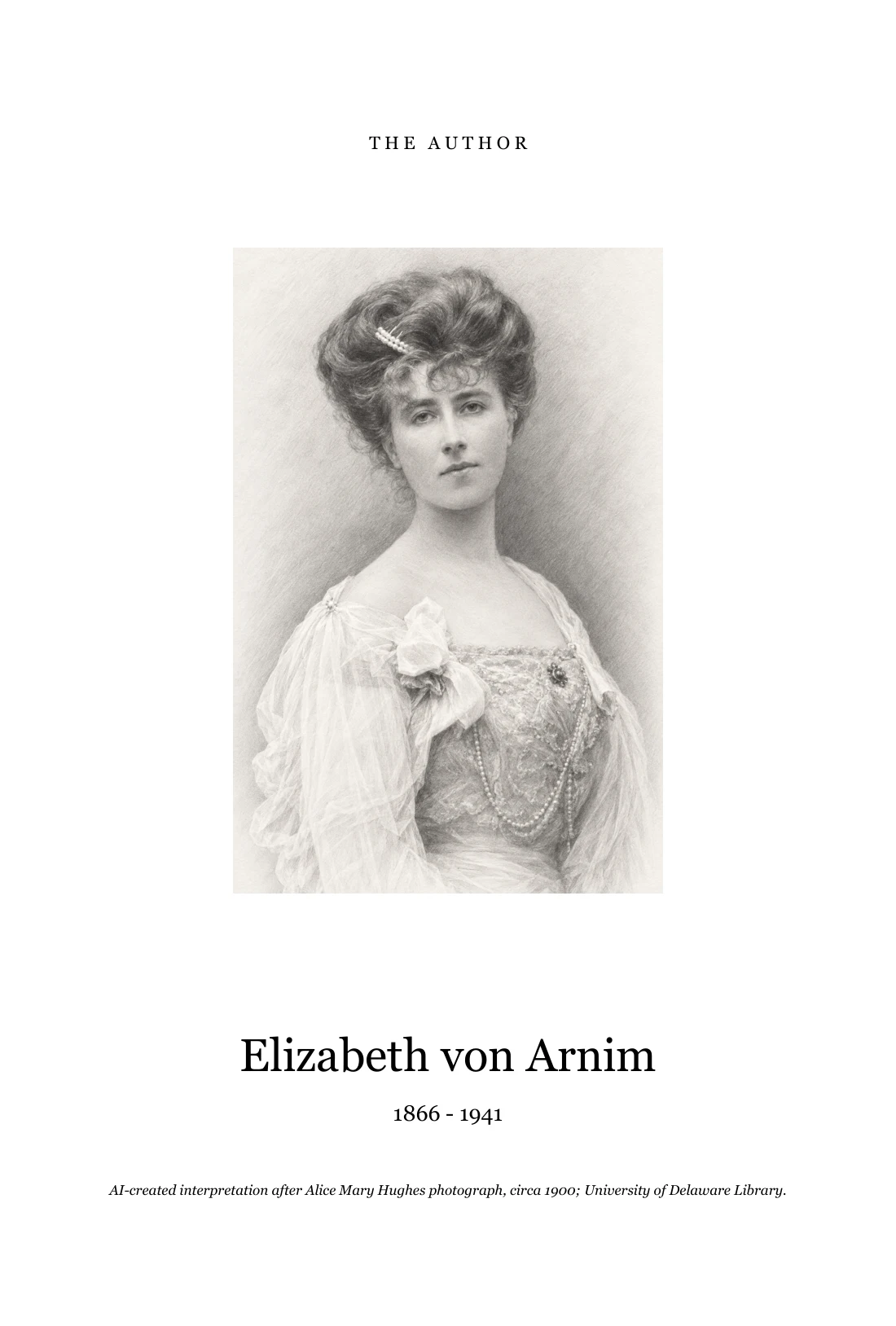
Who was Elizabeth von Arnim?
She was born Mary Annette Beauchamp in Sydney in 1866 and brought up in England. Her first marriage made her a German countess; her second, in 1916, to Frank Russell, the brother of the philosopher Bertrand Russell, made her Countess Russell and failed quickly and acrimoniously. She was a cousin of Katherine Mansfield, and for a time E. M. Forster tutored her children. Her humour is light on the surface and steely underneath, and The Enchanted April is its sunniest expression.
The Enchanted April on stage and screen
The novel was adapted for Broadway in 1925 and filmed in 1935. The best-known version is Mike Newell’s 1991 film, shot at Portofino with Miranda Richardson, Josie Lawrence, Polly Walker and Joan Plowright. It won Golden Globes for Richardson and Plowright and three Academy Award nominations, for Plowright, for Peter Barnes’s screenplay and for its costumes. A new stage version reached Broadway in 2003 and was nominated for a Tony.
For more about the author, read Elizabeth von Arnim and The Enchanted April. If the Riviera has got into your blood, Classic novels set in Italy will keep you there, and Classics for spring has more books for the lengthening days. Book groups will find plenty to argue about in Classics that make great book club picks.
There is no castle to rent and no Box 1000 to write to. But you can do what Mrs Wilkins did, on a grey afternoon, and answer the advertisement anyway: open The Enchanted April at its first page and let April arrive.
Questions readers ask
How does The Enchanted April begin?
With a small advertisement in The Times offering a medieval Italian castle for the month of April, “To Those who Appreciate Wistaria and Sunshine”. Mrs Wilkins reads it in her London club and persuades Mrs Arbuthnot to share the rent.
Where was The Enchanted April set and written?
The novel’s castle, San Salvatore, is fictional, but Elizabeth von Arnim wrote the book at Castello Brown in Portofino, Italy, in 1921, and the town is clearly its model.
Is there a film of The Enchanted April?
Yes. The best known is Mike Newell’s 1991 film starring Miranda Richardson and Joan Plowright, which received three Academy Award nominations. There was also a 1935 film.