
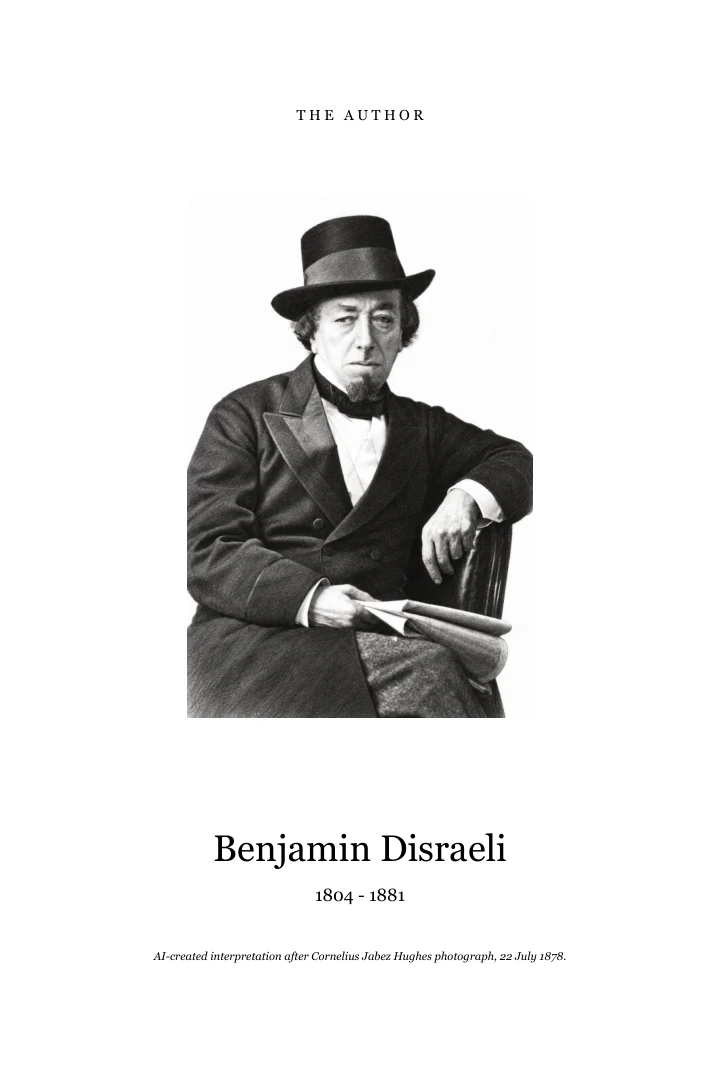
In 1852, when Benjamin Disraeli was Leader of the House of Commons, he sent Queen Victoria regular reports on the day’s debates. She found them “very curious” and, she noted, “much in the style of his books”. By then the books had been coming out for a quarter of a century.
So yes: Benjamin Disraeli was a novelist long before he was prime minister, and well after. His first novel appeared in 1826, when he was twenty-one; he first became prime minister in 1868; and he finished his last novel, Endymion, in 1880, a few months before his death. The Benjamin Disraeli novels track his whole life, from the young man in debt who wanted into society to the elder statesman settling scores in fiction.
Why did Disraeli start writing novels?
Money, mostly. In 1824 and 1825 the young Disraeli, recently out of a solicitor’s office, borrowed to speculate in South American mining shares. The bubble burst, he and his partners lost thousands, and he was still paying off the last of those debts in 1849.
Fashionable “silver-fork” novels about aristocratic life were selling well, so he wrote one. Vivian Grey came out anonymously in 1826–27. It sold, but when society discovered the author was a young man who plainly did not move in the circles he described, the reviews turned savage and the reputation stuck to him for years.

The Benjamin Disraeli novels, in order
He wrote around a dozen full novels, plus shorter satires. These are the landmarks.
- Vivian Grey (1826–27): the scandalous debut, published anonymously.
- Contarini Fleming (1832): his most autobiographical novel, and a poor seller.
- Henrietta Temple (1837): a love story drawn from his own affair with a married woman.
- Coningsby (1844), Sybil (1845) and Tancred (1847): the political novels of the Young England years, often called a trilogy.
- Lothair (1870): written in opposition after his first spell as prime minister, and a bestseller.
- Endymion (1880): his last completed novel, published that November.
- Falconet: left unfinished at his death in 1881, with a priggish hero widely read as a caricature of Gladstone.
- $20.99
Henrietta Temple: A Love Story
1837. A penniless young heir engaged to his rich cousin falls instantly for the girl next door. Debts, secret letters, a spell in a sponging-house and a happy ending: Disraeli at his most romantic and most frankly personal.
- $21.99
Tancred; Or, The New Crusade
1847. A duke’s heir refuses to go into Parliament and sails for Jerusalem to find the spiritual truth England has lost. Part society comedy, part desert adventure, and the strangest of his political novels.


Henrietta Temple: a love story with a debtor in it
Disraeli began Henrietta Temple in 1833, at the start of his affair with Henrietta Sykes, the wife of Sir Francis Sykes, and finished it three years later, after he had ended the relationship. It was published in 1837, the year he was elected to Parliament for Maidstone. The heroine shares her name with his lover, and the hero, Ferdinand Armine, shares his debts.
Its subject, its author insisted, was love at first sight, and he makes the case in a single burst of a paragraph.
There is no love but love at first sight. This is the transcendent and surpassing offspring of sheer and unpolluted sympathy. All other is the illegitimate result of observation, of reflection, of compromise, of comparison, of expediency.
Benjamin Disraeli, Henrietta Temple (1837)
Ferdinand gets out of debt by marrying well and entering Parliament. Within three years of publication Disraeli had done both, marrying Mary Anne Lewis, a well-off widow twelve years his senior, in 1839. If you enjoy Regency-flavoured romance with money troubles, it belongs on our list of books like Bridgerton.

Tancred and the Young England novels
In the 1840s Disraeli led Young England, a small group of Tory aristocrats, most of them friends from Eton and Cambridge, who dreamed of a revived, paternal feudal order. He was its figurehead without being an aristocrat himself, and he wrote three novels in its spirit. Coningsby attacks the politics that followed the Reform Act of 1832. Sybil, subtitled The Two Nations, pictures a country split between the privileged and the poor.
Tancred; or, The New Crusade is the third and the oddest. Its hero, Lord Montacute, shares characters with the earlier books and is expected to come of age, enter Parliament and marry, but wants to visit the Holy Land instead. The great financier Sidonia tells him what he is really after.
It appears to me, Lord Montacute, that what you want is to penetrate the great Asian mystery.
Benjamin Disraeli, Tancred (1847)
He goes, meets the beautiful Eva, daughter of a Jewish banker, and is drawn into the plots of her foster-brother Fakredeen, a scheming Lebanese emir. Critics have long wondered how much of the restless Fakredeen is Disraeli himself, and how much of Tancred’s dream of an Eastern empire foreshadows the prime minister who made Victoria Empress of India. Its English drawing-room chapters have the sharpest lines in the book. “A majority is always the best repartee,” says Coningsby, now a married MP.
Did Disraeli write novels while he was prime minister?
Not while in office, but between and after. Out of power after 1868, he wrote Lothair; a novel by a man who had just been prime minister caused a sensation, and it became a bestseller. He began Endymion in 1872, put it aside when he won the 1874 election and finished it after losing in 1880. Even then he could not resist an old grudge: the novelist St Barbe in Endymion is widely read as a jab at Thackeray, who had parodied him in Punch decades earlier.
For more fiction about power and those who chase it, see classic political novels. And if you want to meet Disraeli the novelist on his own terms, start young and in love. Open Henrietta Temple, and see how quickly Ferdinand decides that first sight is enough.
Questions readers ask
Did Benjamin Disraeli write novels?
Yes. Disraeli wrote novels throughout his life, from Vivian Grey (1826–27) to Endymion (1880), and left an unfinished novel, Falconet, at his death in 1881.
What is Benjamin Disraeli’s most famous novel?
Sybil; or, The Two Nations (1845) is the best known, for its picture of Britain divided into rich and poor. Coningsby and Tancred, its companions, are also widely read.
Which Disraeli novels are best to start with?
Henrietta Temple (1837) is the most approachable, a romantic comedy with a hero in debt. Readers interested in politics should try the Young England novels: Coningsby, Sybil and Tancred.
When was Disraeli prime minister?
Briefly in 1868, from February to December, and again from 1874 to 1880. He was made Earl of Beaconsfield in 1876.
 Sybil418 pages · $20.99