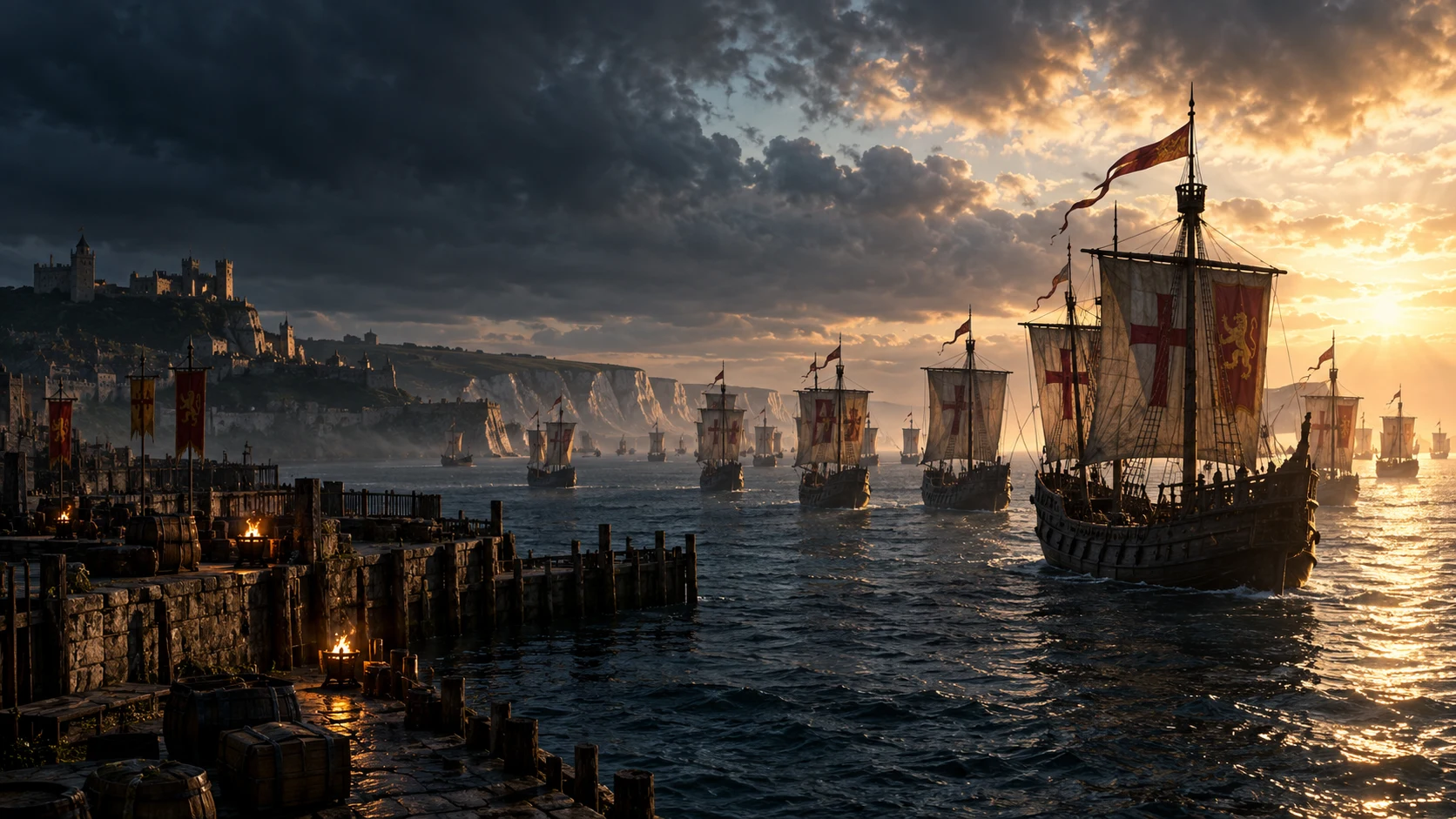
Henry V ends with an advertisement for a play its audience had already seen. After Agincourt, after the wooing of the French princess, the Chorus steps forward to explain that Henry’s triumph did not last: his infant son was crowned, France was lost and England bled, events “Which oft our stage hath shown”.
The Chorus was not exaggerating. By the time Henry V was written, around 1599, the plays about Henry VI and Richard III had been on the London stage for years. William Shakespeare told the story of England’s fifteenth-century civil wars backwards: first the bloody ending, then, a few years later, the reigns that led up to it. So anyone asking for the Shakespeare history plays in order needs to decide which order they mean.
Shakespeare’s history plays in story order
Arranged by the reigns they cover, the English histories run like this. The First Folio of 1623 printed them in this same historical sequence.
- 1199–1216
King John: John’s troubled reign, the death of young Prince Arthur and the barbed wit of the Bastard Faulconbridge.
- 1340s–1350s
Edward III: Crécy, Calais and Poitiers in the Hundred Years’ War; only partly by Shakespeare, and absent from the First Folio.
- 1398–1400
Richard II: a poet-king is deposed by his cousin Bolingbroke, who becomes Henry IV.
- 1402–1403
Henry IV, Part 1: rebellion in the north, Prince Hal in the taverns with Falstaff, and the Battle of Shrewsbury.
- 1403–1413
Henry IV, Part 2: the old king fails, Hal prepares to rule, and Falstaff waits for his reward.
- 1414–1420
Henry V: the invasion of France and the Battle of Agincourt in 1415.
- 1422–1453
Henry VI, Part 1: Henry V is dead, France is slipping away, and the red and white roses are plucked.
- 1445–1455
Henry VI, Part 2: a weak king, a ruthless court and Jack Cade’s rebellion.
- 1455–1471
Henry VI, Part 3: open civil war between York and Lancaster.
- 1471–1485
Richard III: the crookback duke murders his way to the crown and dies at Bosworth.
- 1520–1533
Henry VIII: Wolsey’s fall, Anne Boleyn’s rise and the birth of Elizabeth; written with John Fletcher.
The order Shakespeare wrote them in
Scholars divide the eight central plays into two groups of four, known as tetralogies.
- The first tetralogy, written in the early 1590s: Henry VI, Parts 1, 2 and 3 and Richard III. These cover the Wars of the Roses.
- The second tetralogy, completed by 1599: Richard II, Henry IV, Parts 1 and 2 and Henry V. These cover the earlier reigns, and are sometimes called the Henriad, after Prince Hal.
- Standing apart: King John from the mid-1590s and Henry VIII, a late collaboration usually dated to 1613.
Exact dates are disputed, and Henry VI, Part 1 may have been written with other playwrights, but the broad pattern is not in doubt. Shakespeare was a young writer when he imagined Richard III and a mature one when he created Falstaff, and you can hear the difference.
“Now is the winter of our discontent / Made glorious summer by this son of York”
Richard, Duke of Gloucester, Richard III, Act 1, Scene 1
Which order should you read them in?
For a first reading, start with the second tetralogy, in story order: Richard II, both parts of Henry IV, then Henry V. They are the more polished plays, they make a satisfying four-part story on their own, and they introduce the curse that hangs over everything after: Bolingbroke’s seizure of the crown from an anointed king.
Then read the Henry VI plays and Richard III. You will be reading in story order and, as it happens, meeting a younger Shakespeare at work. If you only have time for two plays, these are the ones most often read and performed on their own.
King Henry V
c. 1599. Hal grown up: the traitors at Southampton, the breach at Harfleur, the night before Agincourt and perhaps the most famous pre-battle speech in English. A Chorus keeps apologising for the size of the stage.
King Richard III
c. 1592–1594. One of Shakespeare’s first great villains, confiding in the audience as he lies and murders his way to the throne. Fiercely entertaining, and the Tudor version of history, not the whole truth.



How accurate are Shakespeare’s history plays?
Not very, and they were never meant to be. His main source, Raphael Holinshed’s Chronicles, already leaned towards the Tudor version of events, and Shakespeare compressed years into scenes, aged and rejuvenated characters to suit the drama, and added comic characters, Falstaff above all, who never existed. Richard III in particular reflects the view of the dynasty that defeated him. The real king’s remains were found under a council car park in Leicester in 2012, on the site of the old Greyfriars friary, and reburied in Leicester Cathedral in 2015.
Watching the history plays
The BBC’s The Hollow Crown filmed the whole eight-play sequence: the second tetralogy in 2012, with Ben Whishaw as Richard II, Jeremy Irons as Henry IV and Tom Hiddleston as Hal, and the Wars of the Roses plays in 2016, with Benedict Cumberbatch as Richard III. For Henry V there are Laurence Olivier’s 1944 film and Kenneth Branagh’s 1989 version; Ian McKellen’s 1995 Richard III moves the story to a 1930s Britain.
For a gentler way in, see which Shakespeare play to read first and how to read Shakespeare. Then begin with the play that makes the best single evening: open King Henry V and let the Chorus ask you to imagine the fields of France inside a wooden O.
Questions readers ask
What order should Shakespeare’s history plays be read in?
In story order: King John, Richard II, Henry IV Parts 1 and 2, Henry V, Henry VI Parts 1 to 3, Richard III and Henry VIII. Many readers start with Richard II and read through to Henry V before going on to the Henry VI plays.
How many history plays did Shakespeare write?
Ten English history plays are usually counted, from King John to Henry VIII. Edward III, now thought to be partly his, is sometimes added as an eleventh.
Did Shakespeare write the history plays in order?
No. He wrote the Henry VI plays and Richard III in the early 1590s, then went back in time for Richard II, Henry IV and Henry V, finishing that sequence around 1599.
What is the Henriad?
The name usually given to Richard II, Henry IV Parts 1 and 2, and Henry V, the four plays that follow Prince Hal’s rise to become Henry V.
 Romeo and Juliet134 pages · $12.99
 Hamlet168 pages · $13.99
 Macbeth106 pages · $11.99
 Othello158 pages · $12.99