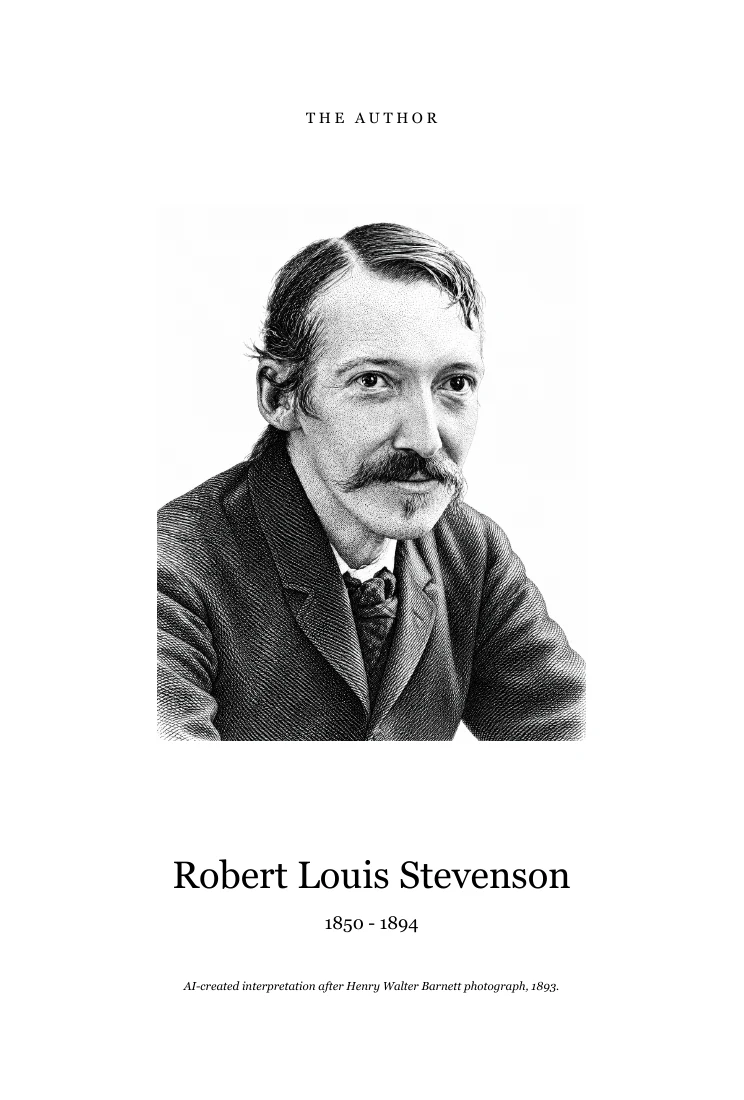
The story usually goes like this. Bournemouth, the mid-1880s. Robert Louis Stevenson, ill and short of money, has a nightmare so vivid that his wife Fanny wakes him, and he grumbles that she has interrupted a fine bogey tale. In a fever of work he writes a first draft of Strange Case of Dr Jekyll and Mr Hyde, reads it to the family, hears Fanny object that he has missed the allegory, and hurls the manuscript into the fire. Then he writes the whole thing again in a matter of days.
Parts of that are true. A first draft almost certainly was destroyed. But nobody can now say for sure whose hand put it on the fire, and the speed of the rewrite has grown in the telling. The history of Jekyll and Hyde rests on a handful of family memories, one remarkable letter and Stevenson’s own, rather different, account.
What the family remembered
Most of the legend comes from Stevenson’s stepson, Lloyd Osbourne, who lived with the couple in Bournemouth. He remembered his stepfather reading the first draft aloud and doubted it had taken even three days to write. In the version that has come down from the household, Fanny’s criticism that the tale ought to be an allegory sent Stevenson to the fireplace.
A second family version has him throwing the pages on the fire in a temper and refusing to let anyone rescue them. Scholars point out that there is no direct, contemporary evidence for either scene. Both are recollections rather than records, told by people who loved him, and both make a flattering story about an author’s artistic courage.

The letter that points to Fanny
In 2000, descendants of the poet W. E. Henley, one of the Stevensons’ closest friends, came across a letter Fanny had written to him in 1885. In it she calls the draft “a quire full of utter nonsense”. Stevenson, she says, has now forgotten all about it, and she will burn it once Henley has seen it. Her husband, she adds, had called it his greatest work.
That does not prove she did it. It does make the familiar picture of the author coolly sacrificing his own pages much harder to believe. A wife nursing a sick husband, privately convinced his new story was rubbish and planning to dispose of it, is a very different scene from the one the biographies painted.
Stevenson’s version: a dream, and a different bonfire
Stevenson told the story of the book himself in “A Chapter on Dreams”, an essay that appeared in Scribner’s Magazine in January 1888. He says nothing about burning Jekyll. He does confess to burning something else: an earlier attempt at the same theme, The Travelling Companion, which he destroyed because Jekyll had taken its place. Then he describes where the new book came from:
For two days I went about racking my brains for a plot of any sort; and on the second night I dreamed the scene at the window, and a scene afterward split in two, in which Hyde, pursued for some crime, took the powder and underwent the change in the presence of his pursuers.
Robert Louis Stevenson, “A Chapter on Dreams” (1888)
So the one manuscript Stevenson admitted in print to burning was not Jekyll and Hyde at all.
How long did Stevenson take to write Jekyll and Hyde?
Longer than three days. The second version seems to have been written in somewhere between three and six, and Stevenson then spent several weeks revising it. Scribner’s published it in New York on 5 January 1886, four days before Longmans, Green issued it in London as a one-shilling paperback of the kind known as a “shilling shocker”.
It was slow to catch on. Booksellers were wary until The Times gave it a warm review on 25 January 1886. After that it sold quickly, close to 40,000 copies within six months by most accounts, and the two names have stood for the divided self ever since.
The book that came out of the fire
Whoever lit the match, the rewrite produced one of the tightest short novels in English. Much of it follows the lawyer Mr Utterson as he tries to make sense of his old friend’s will and his alarming new acquaintance, and its full explanation is held back until Jekyll’s own written statement at the end. That statement contains the idea Stevenson had been chasing through all those drafts:
man is not truly one, but truly two.
Robert Louis Stevenson, Strange Case of Dr Jekyll and Mr Hyde (1886)
Strange Case of Dr Jekyll and Mr Hyde
1886. Fog, locked doors and a respectable doctor’s strange will. Short enough for one evening, unsettling enough to stay with you for weeks.
The Master of Ballantrae
Stevenson’s later novel of two brothers on opposite sides in a Jacobite rising, a darker study of a divided family than Jekyll is of a divided man.


For a wider tour of his books, start with Where to start with Robert Louis Stevenson or visit the Robert Louis Stevenson page. Readers interested in what became of the story afterwards can follow it to stage and screen in Jekyll and Hyde on screen, and for another manuscript that met the flames, see Did you know Gogol burned the second part of Dead Souls?
Then read the version that survived. Strange Case of Dr Jekyll and Mr Hyde takes an evening, and once you know how close it came to being lost, its closing confession reads even more strangely.
Questions readers ask
Did Robert Louis Stevenson burn the first draft of Jekyll and Hyde?
A first draft was almost certainly burned, but the evidence is unclear about who did it. Family memories credit Stevenson, while a letter found in 2000 shows his wife Fanny planning to burn it herself.
How long did it take Stevenson to write Jekyll and Hyde?
The famous claim of three days applies, at most, to the lost first draft. The surviving version took roughly three to six days to write, followed by several weeks of revision.
Where did the idea for Jekyll and Hyde come from?
Stevenson said it came from a dream. In his 1888 essay “A Chapter on Dreams” he described dreaming the scene at the window and Hyde’s transformation in front of his pursuers.
 Treasure Island218 pages · $14.99
 Kidnapped276 pages · $16.99
 The Black Arrow214 pages · $14.99
 Catriona258 pages · $15.99